CKim Group & ILX Travel • E-commerce
CKIM Group: Unifying a Recruitment to Onboarding Pipeline Across Two Companies
Two travel businesses sharing one owner and zero unified HR. When a key team member left, the cracks broke open. We built a complete hire-to-evaluate operating system across six Zoho One apps in 21 days — Blueprint-enforced, handover-resilient, and engineered so any HR coordinator can run either company from day one.

CKim Group & ILX Travel • E-commerce
Two travel businesses sharing one owner and zero unified HR. When a key team member left, the cracks broke open. We built a complete hire-to-evaluate operating system across six Zoho One apps in 21 days — Blueprint-enforced, handover-resilient, and engineered so any HR coordinator can run either company from day one.

About CKim Group & ILX Travel
E-commerce
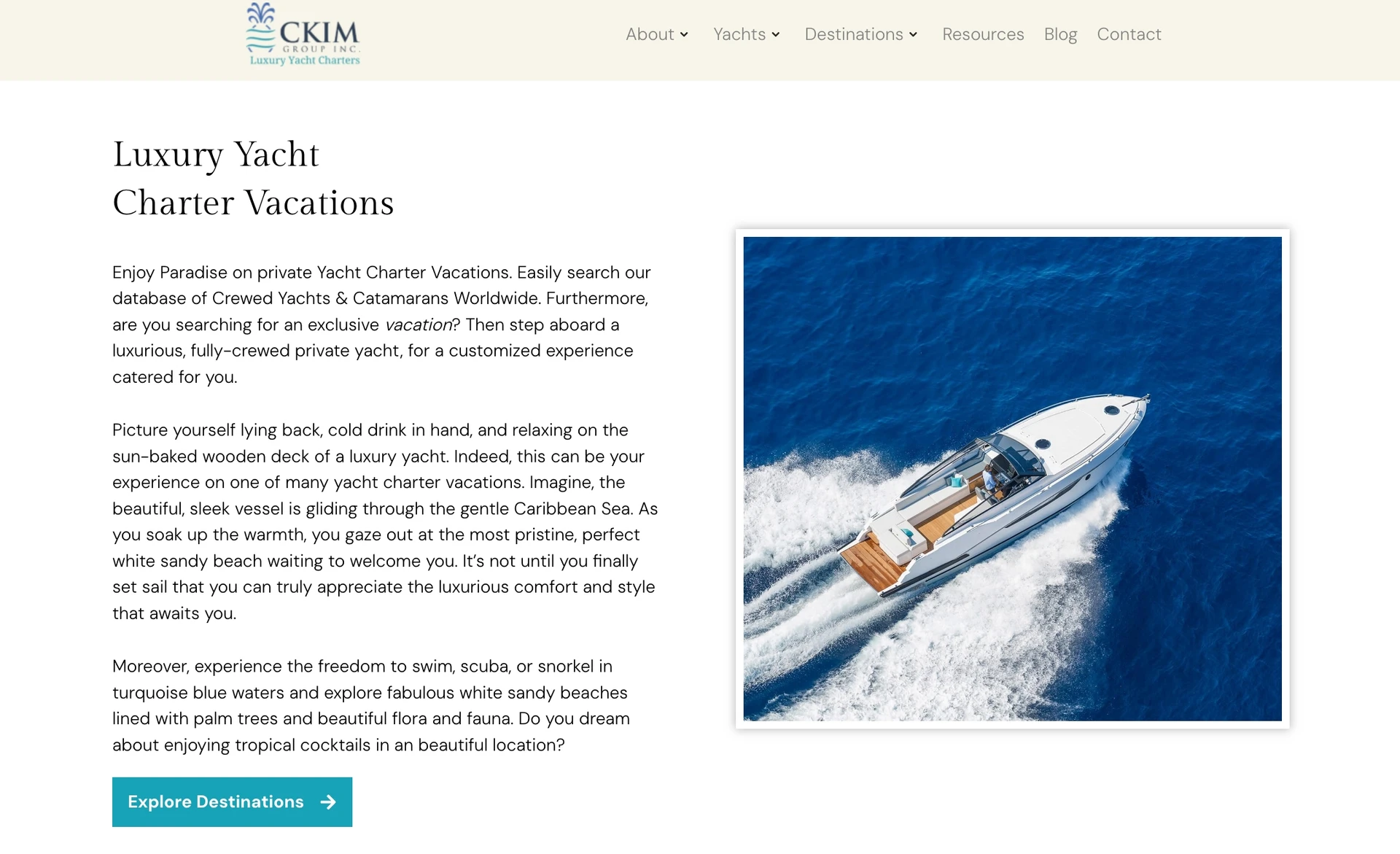
CKIM Group arranges customised yacht charter vacations around the world. They arrange sailing vacations across Europe, the Bahamas, the British Virgin Islands, the U.S. Virgin Islands, and other islands of the Caribbean, as well as Asia, the Galapagos, Belize, Fiji, and French Polynesia.
Visit CKim Group & ILX TravelTwo companies, four systems, zero handover resilience
Chris Patrick runs two travel businesses out of the Philippines — CKim Group, a yacht charter brokerage, and ILX Travel, a global travel agency. Same owner, two teams, two HR models.
The infrastructure backing them was a patchwork: a half-configured Zoho Recruit pipeline, signed contracts dumped in SharePoint, training content buried in a WordPress LMS, and performance evaluations living in spreadsheets nobody could find.
Then Charlotte left in December. Charlotte ran a chunk of the HR operation, and the moment she was gone the cracks were impossible to ignore — the processes she managed didn't exist without her. One team member asked how much leave they had left; there was no system that could answer.
Chris runs his businesses on E-Myth principles — every function should work like a franchise. Documented. Repeatable. Independent of any individual. His HR stack violated every one of them. Four disconnected systems, two companies with fundamentally different permission models, and zero unified view of an employee from application through to evaluation.
One unified HR operating system, built to survive a leaver
We took a manual-first approach: build every process with human gates, validate it works end to end, then layer automation on top. No shortcuts that compound into silent failure modes six months in.
Architecture decisions that mattered:
- One unified pipeline across both companies, spanning six Zoho One apps — Recruit, People, Sign, Learn, Forms, and Flow — sharing the same architecture principles with different permission models for each business.
- Blueprints with enforced stage gates in Recruit (12 stages for ILX, 24 transitions for CKim). HR coordinators can't skip steps regardless of who is at the keyboard.
- Org structure mapped to E-Myth functional departments. Every recruitment stage, onboarding task, and evaluation cycle ties to a role — not a person — so handover is built in from day one.
- 30/60/90-day evaluation triggers fire automatically from the date of joining. Weighted dual-input scoring across Role Outcomes (50%) and Core Values (50%). Two policy frameworks, one engine.
- Zoho Sign replaces SharePoint for contracts. Three templates — IC Agreement, Handbook, Policies. Once signed, the employee record is created automatically and the onboarding flow kicks off.
Tools We Integrated








Two companies, four systems, zero handover resilience
Chris Patrick runs two travel businesses out of the Philippines — CKim Group, a yacht charter brokerage, and ILX Travel, a global travel agency. Same owner, two teams, two HR models.
The infrastructure backing them was a patchwork: a half-configured Zoho Recruit pipeline, signed contracts dumped in SharePoint, training content buried in a WordPress LMS, and performance evaluations living in spreadsheets nobody could find.
Then Charlotte left in December. Charlotte ran a chunk of the HR operation, and the moment she was gone the cracks were impossible to ignore — the processes she managed didn't exist without her. One team member asked how much leave they had left; there was no system that could answer.
Chris runs his businesses on E-Myth principles — every function should work like a franchise. Documented. Repeatable. Independent of any individual. His HR stack violated every one of them. Four disconnected systems, two companies with fundamentally different permission models, and zero unified view of an employee from application through to evaluation.
One unified HR operating system, built to survive a leaver
We took a manual-first approach: build every process with human gates, validate it works end to end, then layer automation on top. No shortcuts that compound into silent failure modes six months in.
Architecture decisions that mattered:
- One unified pipeline across both companies, spanning six Zoho One apps — Recruit, People, Sign, Learn, Forms, and Flow — sharing the same architecture principles with different permission models for each business.
- Blueprints with enforced stage gates in Recruit (12 stages for ILX, 24 transitions for CKim). HR coordinators can't skip steps regardless of who is at the keyboard.
- Org structure mapped to E-Myth functional departments. Every recruitment stage, onboarding task, and evaluation cycle ties to a role — not a person — so handover is built in from day one.
- 30/60/90-day evaluation triggers fire automatically from the date of joining. Weighted dual-input scoring across Role Outcomes (50%) and Core Values (50%). Two policy frameworks, one engine.
- Zoho Sign replaces SharePoint for contracts. Three templates — IC Agreement, Handbook, Policies. Once signed, the employee record is created automatically and the onboarding flow kicks off.
Tools We Integrated
Results
Twenty-one days from kickoff to a fully operational HR system across both companies. Six Zoho apps unified, two recruitment Blueprints with enforced stage gates, two onboarding flows (seven stages each), 30/60/90-day auto-evaluation triggers, 9 Learn spaces with 41 training manuals, leave management with approval workflows, and three Zoho Sign templates replacing SharePoint.
The deeper outcome isn't the app count — it's that any HR coordinator can run either company's hiring process from day one. The process is in the system, not in someone's head. When the next Charlotte leaves, the business doesn't notice.
Days to deploy
Full HR system live across both companies, kickoff to handover.
Zoho apps unified
Recruit, People, Sign, Learn, Forms, Flow — one pipeline.
Recruitment Blueprints
Stage-gated. The process lives in the system, not in someone's head.
Results
Twenty-one days from kickoff to a fully operational HR system across both companies. Six Zoho apps unified, two recruitment Blueprints with enforced stage gates, two onboarding flows (seven stages each), 30/60/90-day auto-evaluation triggers, 9 Learn spaces with 41 training manuals, leave management with approval workflows, and three Zoho Sign templates replacing SharePoint.
The deeper outcome isn't the app count — it's that any HR coordinator can run either company's hiring process from day one. The process is in the system, not in someone's head. When the next Charlotte leaves, the business doesn't notice.
Days to deploy
Full HR system live across both companies, kickoff to handover.
Zoho apps unified
Recruit, People, Sign, Learn, Forms, Flow — one pipeline.
Recruitment Blueprints
Stage-gated. The process lives in the system, not in someone's head.